
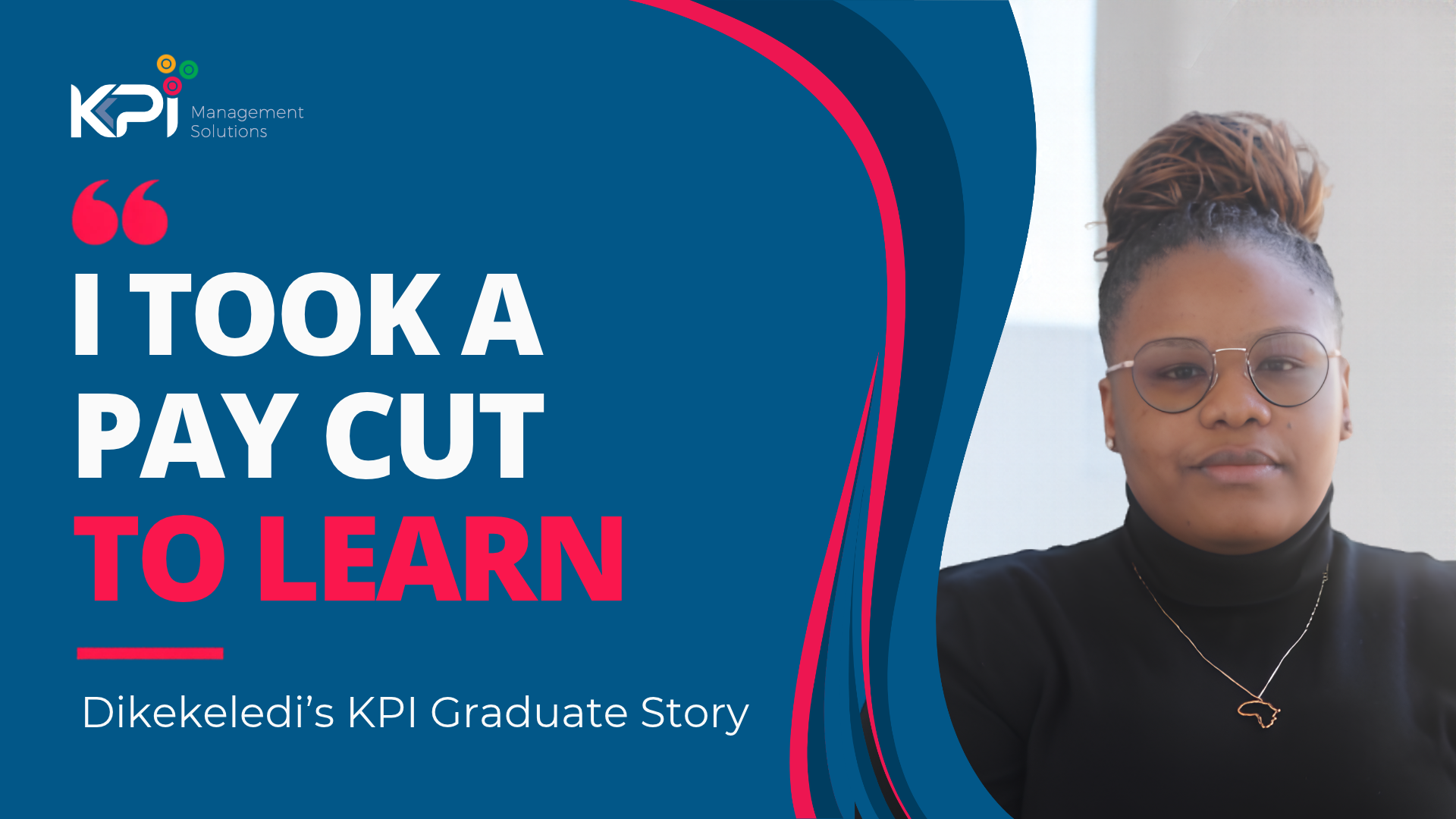
"Are you willing to take a pay cut just to learn the skills you want to learn?"
That was the question Dikeledi had to answer when she heard about the KPI Graduate Programme.
On paper, she was already on a good path. She had a BCom in Statistics from the University of Pretoria and was working at Investec, supporting its UK team in financial crime. It was valuable work, but it wasn't where her interests lay. She loved statistics, and she wanted to get back to working with data.
A former university classmate, told her about the programme. The opportunity was exactly what she was looking for, but it came with a catch: she would earn less.
A Step Back to Move Forward
Her answer was an enthusiastic yes.
We tend to associate career progression with earning more, moving up and taking on greater responsibility. That is how most of us measure whether a career is going well. But sometimes getting closer to the work you want to do means taking a financial step backwards while you invest in yourself.
That is not an easy decision, and it is not one everyone can make. But it says a great deal about what Dikeledi valued: the skills she would gain mattered more to her than the salary she would give up. And for her, that decision was only the beginning.
The Internship Within the Internship
Dikeledi describes the programme as a difficult journey at times. One of the things she remembers most is looking at the work of another graduate with an extraordinary ability to find insights in data. She would study his work and wonder how he saw things she had missed.
In that situation, it would have been easy to see him as competition. Instead, she asked him to teach her.
What followed was what she jokingly calls "an internship within the internship": hours spent working together, asking questions and learning from someone who approached problems differently. She also turned to Davina for guidance, and gradually discovered the value of being surrounded by people who were willing to share what they knew.
That willingness to learn from one another became one of the things she valued most about the programme. Even when someone produced good work, another graduate might come along and ask whether they had considered a different approach. Having people who approached the same problems differently gave everyone an opportunity to question their assumptions and improve their work.
She also remembers Davina telling her that one of her dashboards wasn't good enough. What I like about that moment is that she didn't spend her energy defending the dashboard. She went back and improved it. The feedback only became valuable because she did something with it.
When Dikeledi shared her graduation story, she was working as a technology consultant at one of the Big Four firms, specialising in cloud analytics. She spoke about being able to help colleagues with Power BI, sharing skills she had once needed others to teach her. The person who once spent hours asking how others did something had become someone who could share that knowledge herself.
Looking back at Dikeledi's experience, what stands out is that she didn't simply take a pay cut to acquire technical knowledge. She entered an environment where people were prepared to spend hours teaching one another. There is a difference between acquiring knowledge and being part of an environment where people help one another learn.
What It Takes to Develop People
We often talk about creating opportunities for young talent, and rightly so. But opportunities alone don't develop people. Someone has to be willing to share what they know, challenge someone's thinking and invest the time to help them improve. And the person receiving that support has to be willing to ask questions, accept feedback and put in the work.
Dikeledi's story is a reminder that development is rarely something one person achieves entirely on their own. Her willingness to learn mattered. So did the willingness of the people around her to teach.
She was prepared to earn less to learn more. Along the way, she discovered that some of the most valuable learning comes from the people sitting right next to you.
🎥 Watch Dikeledi share her graduation story in her own words