Talent Is Everywhere. Pathways Aren't.
The Talent Is There. Are We Creating Enough Opportunities for It to Grow?
Almost every applicant to our graduate programme is a young person of colour.
What strikes me is not who applies. It is how much exceptional talent is still sitting outside the traditional routes into business, waiting for somebody to notice it, back it and give it a chance to develop.
I see the other side of this when graduates have been through our programme and we introduce them to clients. Clients are often genuinely surprised by the quality of the people they meet. These are capable, ambitious young professionals who, in many cases, those organisations may never have found through their normal recruitment channels.
Which raises an uncomfortable question.
If the talent is so obvious once it is in front of us, why was it so difficult to see before?
The talent was there all along. What was missing was a route into business and somebody willing to back it early.
Talent Does Not Suddenly Appear at Senior Level
We often talk about talent as though it is something organisations simply need to go out and find. A vacancy appears, the search begins, and somewhere out there is the person with the right experience, skills and track record.
But exceptional professionals do not arrive fully formed.
They develop. Someone gives them their first opportunity. They enter a workplace, learn how it operates, make mistakes, build confidence, take on more responsibility and, over time, become the experienced people everybody wants to recruit.
There is a strange contradiction here. Businesses want strong pools of experienced talent, but much of the recruitment market is focused on people who have already been developed by somebody else. We compete for the finished product while investing less attention in where the next generation of that talent will come from.
That works for an individual appointment. I am less convinced it works as a long term talent strategy.
The Springboks Offer a Useful Lesson
South African rugby gives us a useful comparison.
The flair and ability we see at Test level does not suddenly appear when somebody pulls on a Springbok jersey. By then, we are seeing the result of years of development.
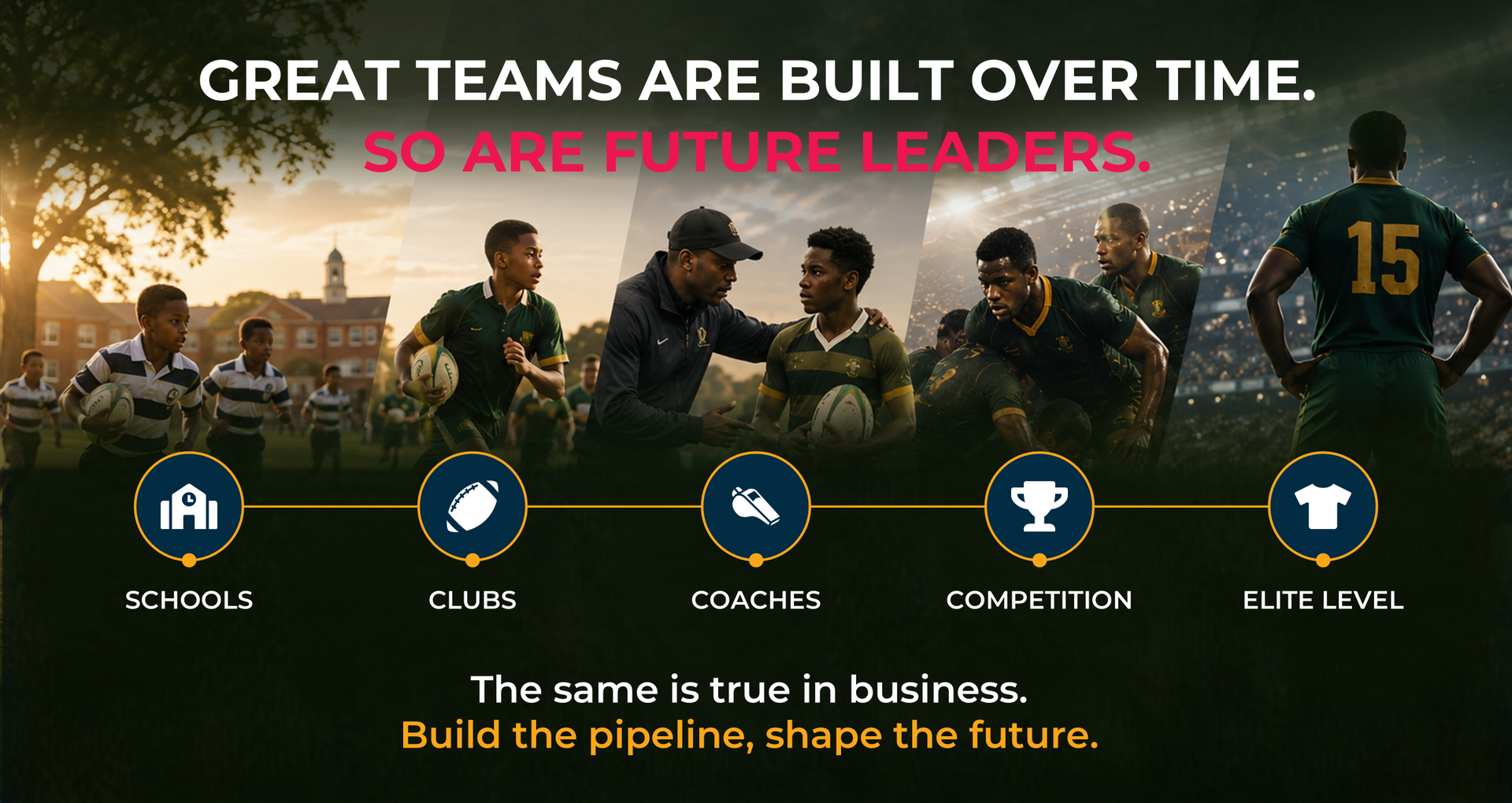
Long before that player reaches the national team, somebody has noticed potential. Schools create opportunities to play. Clubs provide another level of competition. Coaches invest time. Players test themselves against stronger opposition, develop physically and mentally, learn from failure and gradually move through the system.
Some will reach the highest level. Most will not. That is the nature of a development pipeline.
But remove the system underneath the Springboks and eventually there is a problem at the top.
Business is not so different.
If we want exceptional finance managers, specialists, CFOs and business leaders ten or fifteen years from now, then somebody needs to be developing the graduates and young professionals who might eventually become them.
We cannot only recruit at the top of the pipeline and expect the bottom to take care of itself.
Someone Has to Give People Their First Opportunity
This is where graduate programmes, bursaries and structured development programmes matter.
Their value goes far beyond filling junior vacancies. They create an entry point into a system that can otherwise be surprisingly difficult to enter, particularly for talented young people who do not have established professional networks, previous corporate experience or the kind of background that makes them immediately visible through traditional recruitment channels.
This is an important distinction. Creating access is not the same as lowering the bar.
If anything, our experience suggests the opposite. We repeatedly meet young people with enormous capability who simply need the opportunity to demonstrate it. Once they have had that opportunity, clients sometimes ask us where we found them.
Perhaps the more interesting question is why they were not being found before.
That question matters in South Africa because there is a temptation to discuss skills shortages as though the only problem is the supply of capable people. Sometimes the capability exists. What is missing is the bridge between potential and the workplace.
Graduate development can be that bridge.
Simple Does Not Mean Easy
There is a tendency in business to give more weight to solutions that sound sophisticated. Finding a highly experienced person with exactly the right technical background can feel like the harder, more serious talent decision.
Developing someone from the beginning can sound almost obvious by comparison.
But obvious is not the same as easy.
A good graduate programme requires careful selection, patient managers, meaningful work, feedback, training and enough room for people to stretch without being abandoned. The principle is simple. Doing it well is not.
That distinction matters because we often confuse technical complexity with value. Some of the most valuable things an organisation can do are conceptually straightforward and operationally difficult.
Developing people is one of them.
Growing Inside a Business Creates a Different Kind of Value
There is another advantage to developing people internally that is easy to underestimate.
Someone who grows inside a company learns far more than the technical requirements of their role. They learn how the systems actually work. They understand the culture. They build relationships across departments and discover who to speak to when something goes wrong.
They also accumulate context.
They know why certain decisions were made. They remember what has been tried before. They understand which processes look strange from the outside but exist for a reason, and which processes probably should have disappeared years ago.
Over five or ten years, that knowledge becomes enormously valuable.
I sometimes think of it as earning a master's degree in that particular business. It is not a qualification anyone puts on the wall, but it represents years of accumulated understanding that cannot simply be bought in the external recruitment market.
You can recruit experience. You can recruit expertise. You can recruit a different perspective, and sometimes that is exactly what a business needs.
But you cannot instantly recruit ten years of knowing your organisation.
That has to be built.
Development Is a Long-Term Investment
This is why I have so much respect for organisations that continue investing in bursaries, graduate programmes and training, particularly when there is pressure to demonstrate an immediate return on almost every investment.
The return on developing people is not always neat.
Some graduates will leave. Some will take the experience you gave them and build careers elsewhere. Some will discover that the profession or industry is not right for them. Others will stay and, years from now, become the managers and leaders the organisation needs.
That uncertainty can make external recruitment seem easier. There is a vacancy today, so we find somebody who can do the job today.
There is nothing wrong with that. Businesses will always need external recruitment.
The problem comes when everybody relies on the same strategy.
If every organisation waits for somebody else to train the graduates, develop the professionals and create the managers, we eventually end up competing for the same limited pool of experienced people.
Someone has to build.
From Graduate to Future Leader
A healthy talent pipeline creates movement through an organisation.
Graduates become experienced professionals. Experienced professionals become specialists and managers. Some managers become senior leaders. As people progress, opportunities open beneath them for the next group to enter and develop.
Over time, the organisation becomes less dependent on finding fully developed talent every time a vacancy appears because it is creating more of its own.
This does not mean promoting internally at all costs. That creates a different set of problems. Organisations still need external experience, specialist skills, fresh thinking and people who have seen different ways of doing things.
The goal is balance.
External recruitment should strengthen a talent pipeline, not become a substitute for having one.
When internal development and external recruitment work together, the organisation gains something from both. It retains institutional knowledge while continuing to introduce new experience and perspectives.
The Opportunity Is Part of the Talent Strategy
South Africa does not lack capable young people.
We see evidence of that every time we run a graduate programme. The raw material is there: intelligence, ambition, resilience, curiosity and a desire to build meaningful careers.
What many young people do not have is the first opportunity to show a business what they can become.
That changes how I think about graduate development. It is not simply a recruitment initiative and it is not something that should sit on the edge of a broader talent strategy.
It is part of the talent strategy.
It creates access today while building capability for tomorrow. It allows organisations to discover people they might otherwise miss and gives those people the experience through which potential becomes professional capability.
There is also a broader consequence.
When businesses create genuine routes into professional careers, they are not only changing the trajectory of individual graduates. They are gradually changing the pool from which South Africa's future managers and leaders will emerge.
That does not happen in a year.
Neither does developing a Springbok.
A Different Question About Talent
Perhaps we need to change the question.
Instead of only asking, "Where can we find the experienced people we need?", organisations could also ask, "Who are we developing now who might become the people we need later?"
Those are different questions, and they lead to different behaviours.
The first sends us into the market.
The second forces us to look at our own responsibility for creating the market we hope will exist in five or ten years.
We need both.
But if we only ever ask the first question, we should not be surprised when everybody ends up competing for the same people.
Final Thought
One Final Question
Are you waiting for future leaders to appear, or are you building the pathways that will develop them?