

Why Succession Planning Keeps Falling Off the Agenda
Why waiting until a senior leader leaves turns a manageable succession challenge into an expensive recruitment problem.

It Was on Last Year's Agenda Too
Succession planning might be the most agreed upon idea in South African business that nobody actually does.
I've sat in plenty of strategy sessions. It lands on the list every single year.
Everyone nods, everyone agrees it matters, and we all say we really must get our succession plans in place this time.
Then we come back twelve months later, admit we never got to it, and put it straight back on the list for next year.
The strange part is that succession isn't hard in theory.
It's just never urgent until the day it's the only thing that matters.
Succession Planning Only Becomes Urgent When Someone Leaves
A senior person resigns.
Suddenly, something that could never quite make it to the top of the priority list becomes everyone's problem.
The business needs a replacement.
The work still needs to get done.
The team needs leadership.
Clients and stakeholders still expect answers.
And the knowledge that took years to build is about to walk out the door.
The same organisation that couldn't find time for succession planning suddenly finds the budget for an external search and the time for interviews.
Then comes the gap while the role is vacant, followed by the months it can take someone new to understand the business, the people and the decisions behind the numbers.
At that point, it looks like a recruitment problem.
It isn't.
It's a succession gap that was there long before the resignation letter arrived.
The Real Cost Isn't Just Recruitment
When a critical person leaves without a ready successor, the obvious cost is finding a replacement.
But that's only part of it.
Think about what else potentially leaves with that person.
Years of institutional knowledge.
Relationships built across the organisation.
An understanding of why certain decisions were made.
Knowledge of the systems, processes and workarounds that aren't written down anywhere.
Context that exists in someone's head rather than in a procedure manual.
Then there is the cost of the gap itself.
Other people absorb the workload.
Decisions slow down.
Senior leaders spend time interviewing candidates.
The team operates without permanent leadership.
And once someone is appointed, they still need time to become fully effective.
The real cost of poor succession planning isn't simply replacing a person.
It's replacing everything the organisation allowed to depend on that person.
Why Succession Planning Keeps Getting Delayed
I don't think most organisations ignore succession because they believe it isn't important.
Quite the opposite.
Everyone agrees it's important.
That's part of the problem.
Because everyone agrees, it feels safe to move it to next month.
There is always something more urgent.
A budget needs to be completed.
A forecast needs updating.
A system needs implementing.
A customer needs attention.
A deadline has moved.
A vacancy needs filling.
Succession planning doesn't usually create an immediate consequence when you postpone it.
Nothing breaks today.
Nobody complains.
Revenue doesn't suddenly disappear.
So it moves down the list.
Again.
And again.
Until someone resigns.
Then suddenly it isn't a people development initiative for next quarter.
It's a business continuity problem for Monday morning.
Succession Planning Is a Pipeline, Not a List of Names
One of the mistakes I see is treating succession planning as a spreadsheet exercise.
We identify the important positions.
Then we put a name next to each one.
CFO → Potential successor.
Finance Manager → Potential successor.
Head of Reporting → Potential successor.
Done.
Except it isn't.
Having someone's name on a succession plan doesn't make them ready to do the job.
A real succession plan asks much harder questions.
Who could genuinely step into this role?
What capability are they missing today?
What experience do they need?
What decisions have they never had to make?
What relationships do they need to build?
Where can we give them exposure now?
And if they move up, who is ready to take their place?
That's when succession planning stops being a list of names and starts becoming a talent pipeline.
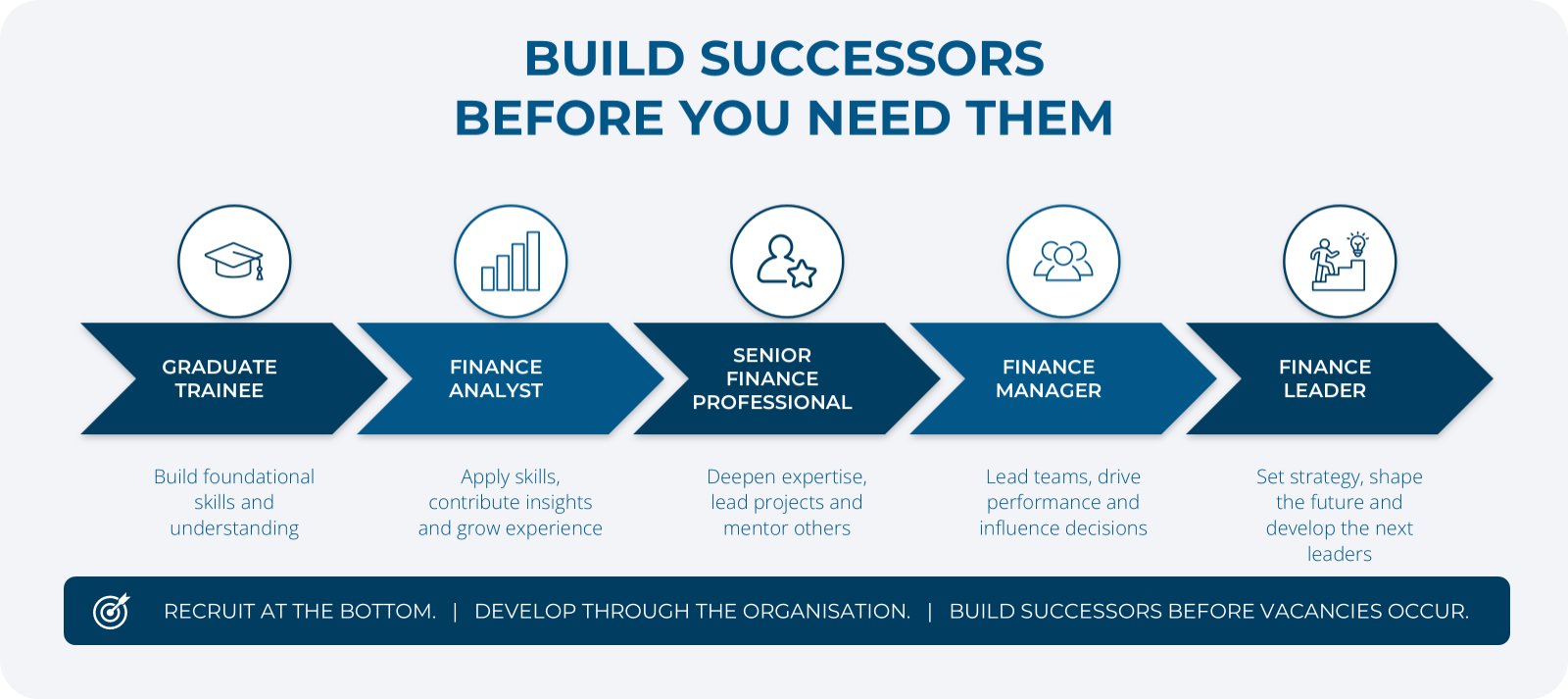
Build the Successor Before You Need Them
The best time to develop someone's successor isn't when they resign.
It's while they're still there.
That's when knowledge can be transferred properly.
That's when someone can sit in on important meetings before they need to lead them.
That's when they can take responsibility for increasingly difficult decisions while an experienced leader is still there to coach them.
That's when mistakes can become development opportunities rather than business crises.
People don't become ready for leadership because their name appears on an organisation chart.
They become ready through experience.
Learn → Gain exposure → Take responsibility → Make decisions → Receive coaching → Lead
That takes time.
Which is exactly why succession planning can't begin when the vacancy appears.
What Good Succession Planning Looks Like
Good succession planning doesn't need to become an enormous annual exercise.
It needs to become part of how the organisation develops people.
Start with the roles that would hurt most if they became vacant tomorrow.
Ask who could potentially step into each one.
Then be realistic about whether those people are ready.
If they're not, identify what stands between where they are today and where they need to be.
Give them the exposure.
Give them responsibility.
Let them work alongside the people whose roles they may eventually take over.
Coach them.
Test them.
Develop them before you need them.
Because a succession plan isn't really about identifying who comes next.
It's about making sure they're ready when next arrives.
The Link Between Succession and Your Talent Pipeline
This is why I don't think succession planning can be separated from talent development.
If you only start looking at your people when a senior vacancy appears, you're already too late.
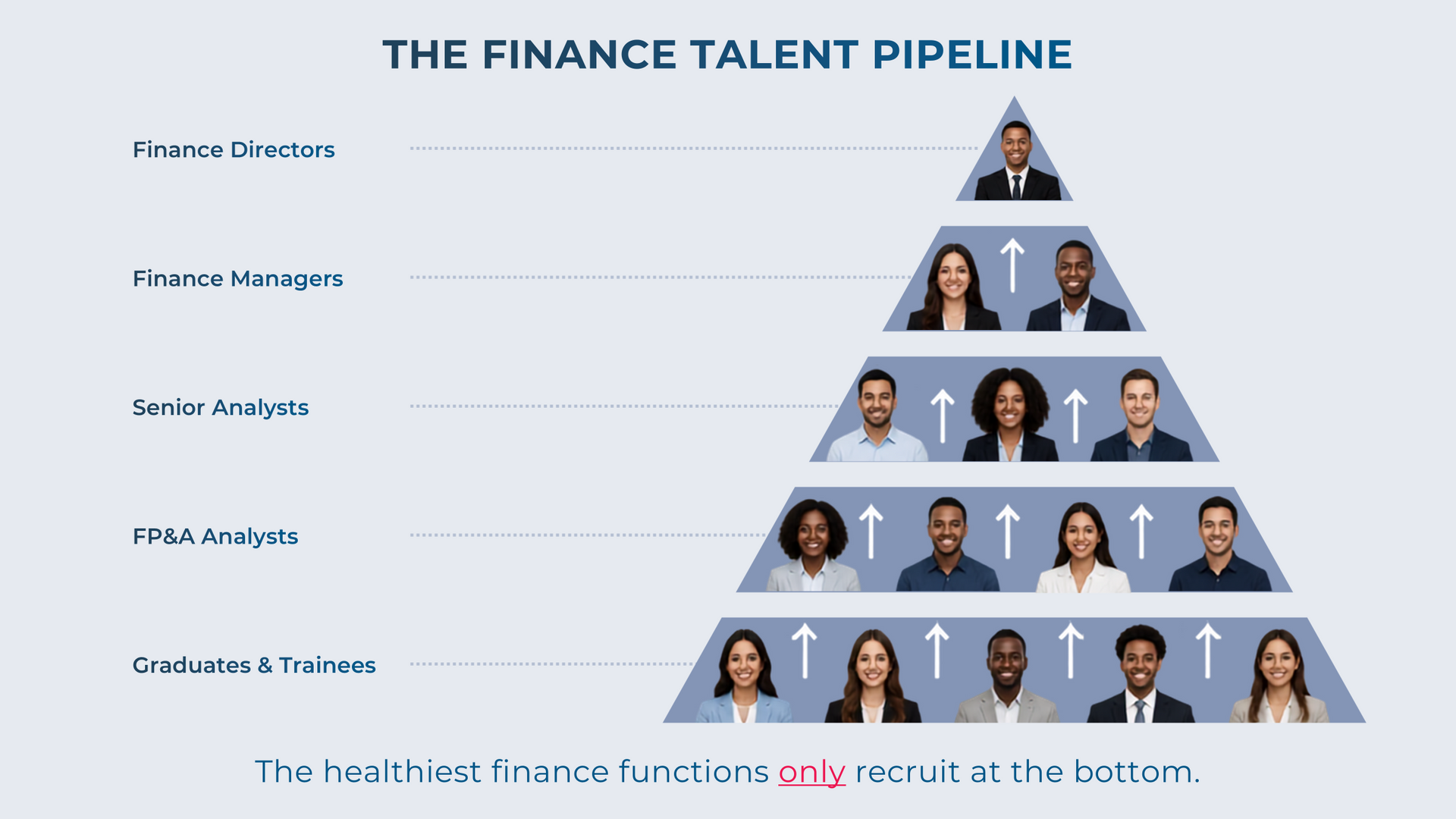
A healthy organisation is constantly building capability from the bottom up.
Graduates develop into analysts.
Analysts develop into specialists.
Specialists become managers.
Managers become leaders.
And every time someone moves up, another person has the opportunity to follow.
That's a talent pipeline.
Succession planning simply makes sure that pipeline is moving people towards the capabilities the organisation will need next.
Key Takeaways
- Succession planning is not a once a year exercise. It needs to happen continuously.
- The cost of poor succession extends beyond recruitment. Organisations can also lose knowledge, productivity, relationships and time.
- A list of potential replacements isn't a succession pipeline. Future leaders need deliberate development before vacancies occur.
- Internal capability takes time to build. Starting after someone resigns is already too late.
- The strongest organisations develop successors before they need them.
Final Thought
The strange part is that succession isn't hard in theory.
We know it matters.
We usually know which roles would hurt if they suddenly became vacant.
We often even know which people have the potential to step up.
What we don't do consistently is give those people the experience, exposure and development they need before the vacancy arrives.
So succession planning goes back onto the agenda.
Next quarter.
Next year.
When things quieten down.
Until one day, someone resigns.
And suddenly there isn't any more time.
The organisations that handle succession well aren't necessarily better at predicting who will leave.
They're better at being ready when someone does.
One Final Question
If one of your critical finance leaders resigned tomorrow, who could genuinely step into the role?
And more importantly, what are you doing today to make sure they're ready?