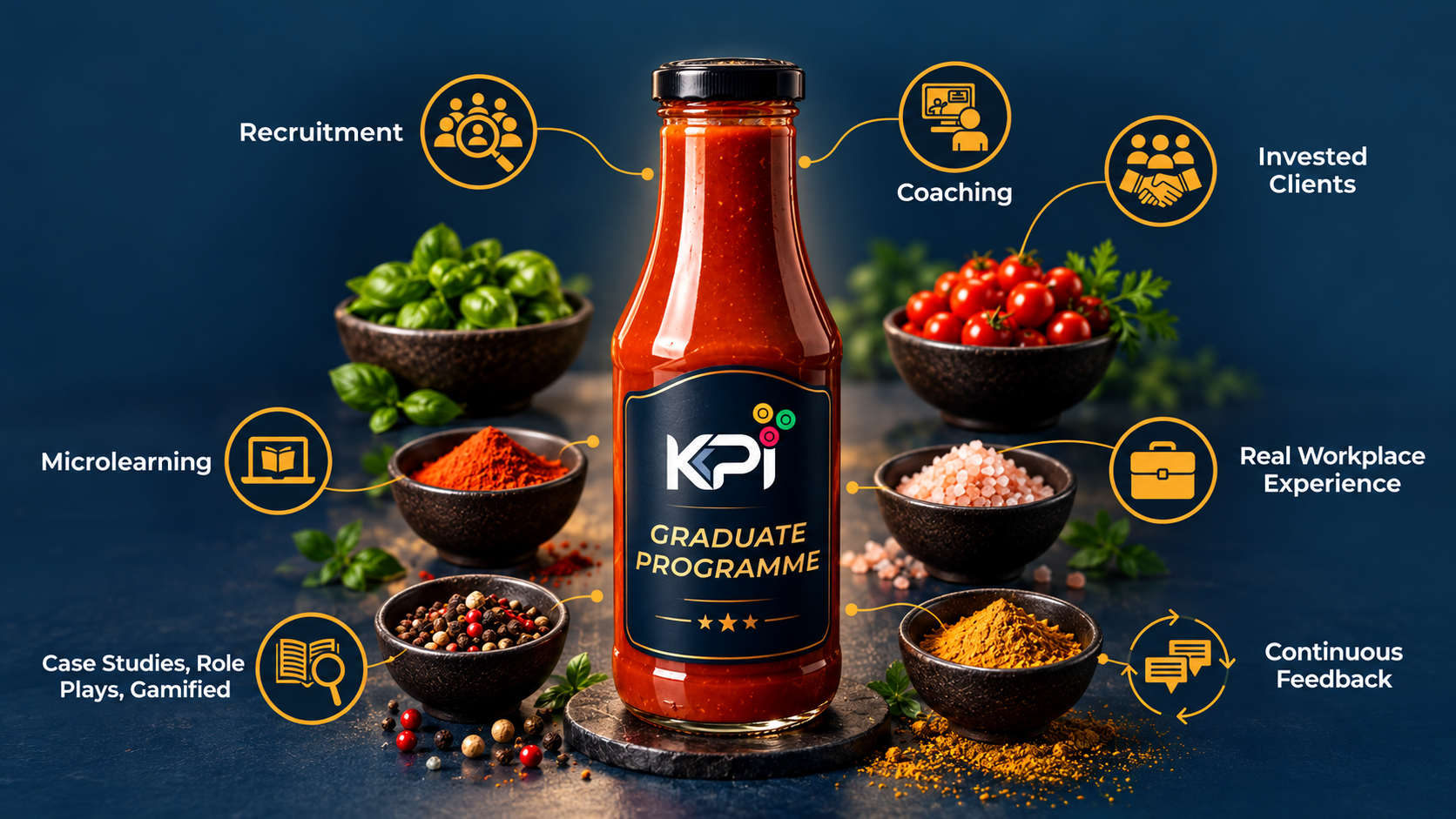
What’s Really in Our Secret Sauce?
Why the way graduates learn matters as much as what they learn
Imagine being a graduate, standing in front of a room of experienced businesspeople, presenting your analysis of a problem. You have prepared your numbers, built your presentation and worked through what you think the data is telling you.
Then the questions begin.
Where did that number come from? Why have you reached that conclusion? What would you recommend the business actually do?
You have to think while people are watching. You need to defend your reasoning, recognise when something does not make sense and explain your findings clearly enough for other people to act on them.
Now imagine doing that around forty times in a year.
That is one of the things we do in our graduate programme at KPI Management Solutions. And I believe it helps explain something important about why our graduates become valuable to employers.
The number behind the number
Teaching someone a tool is not the same as teaching them to think
I have spent many years working in data analytics, and one of the things I have learned is that knowing how to operate software is only one part of being a good analyst.
You can attend an Excel course or learn Power BI. You can understand how to build charts, connect data and create reports. Those are useful skills, and people need them.
But then a manager asks a question that was never anticipated when the report was designed.
Can you investigate the data? Can you identify what is unusual? Can you explain why something is happening? And, perhaps most importantly, can you connect your analysis to a decision the business needs to make?
That requires something more than knowing where to click.
We teach technical skills, but we also spend a great deal of time developing analytical thinking, critical thinking and the ability to work through unfamiliar problems.
The aim is not simply to produce someone who can operate a system.
It is to develop someone who can use information intelligently.
Why we keep the theory short
Traditional training can easily become focused on how much content is covered. The assumption seems reasonable: if the subject is complex, perhaps the answer is to teach more of it.
Our experience has led us in a different direction.
Some of our lessons are only fifteen minutes long. We introduce a concept and then ask the graduates to apply it. They work with the software, solve problems and very quickly discover what they understand and where they are struggling.
When they get stuck, our coaches work alongside them.
We call this microlearning, but the important part is not that the lesson is short. The important part is what happens immediately afterwards.
Learning and application sit close together.
A short explanation followed by meaningful practice can be more useful than hours of theory that the learner has no immediate opportunity to use.
That does not make the subject easier. Data engineering, analytics and automation can be technically demanding. We are not removing the complexity. We are translating it into something people can learn, practise and eventually use with confidence.
Making something usable is not the same as making it simplistic.
The classroom becomes a business meeting
Every week, our graduates work through case studies. They present their thinking, respond to questions and learn to explain why they have reached a particular conclusion.
We also use role plays and an approach inspired by the format of Idols, where participants have to perform and respond to a panel. Sometimes I play the difficult person asking the questions.
There is a reason for that.
A real manager does not always ask a carefully structured question. An executive may challenge an assumption. Someone may want an answer immediately. A number may suddenly not make sense.
The analyst has to remain composed, understand what is really being asked and respond with evidence rather than simply repeat what appears on the screen.
Doing this repeatedly changes the way people respond to being challenged.
Over the course of a year, those presentations help graduates develop confidence, communication skills and the ability to explain their thinking under pressure. They learn to participate meaningfully in a business conversation.
Learning and doing, every week
I have written before about why our graduates spend four days a week in the host organisation and one with us. What I want to focus on here is what that rhythm does to learning.
A graduate returns to training with questions that have come from actual experience. A number that did not reconcile. A manager who asked something they could not answer.
They then go back to the workplace with new ideas and skills they can test the next day.
That movement between learning and doing matters more than either half on its own.
Feedback needs to happen while it can still make a difference
We also measure progress throughout the programme.
Our scorecard brings together feedback from trainers and workplace mentors. We look at areas such as communication, data capability, quality of work and timeliness, and progress is reviewed each month.
That means the mentor inside the business is not only supporting the graduate. They are helping to shape the development process because what they see in the workplace feeds directly into what we do in training.
Our trainers see something different. Bringing those perspectives together gives us a fuller picture of where someone is developing and where they need more support.
The point is not to create another performance management process. It is to identify what needs attention while there is still time to do something about it.
That keeps the learning responsive.
The graduate who did more than complete the task
A client recently told me about one of our graduates who had been asked to work on a scorecard for advisers.
He could have completed the assignment exactly as instructed and moved on.
Instead, he started questioning the assumptions behind the process. He wanted to understand why things were being done in a particular way. He challenged aspects of the approach and redesigned parts of the process.
According to the client, this was not an isolated incident. The graduate had behaved in a similar way on other assignments.
What impressed the manager was not simply that he could complete the work.
He thought about the work.
For me, that distinction captures something important about capability.